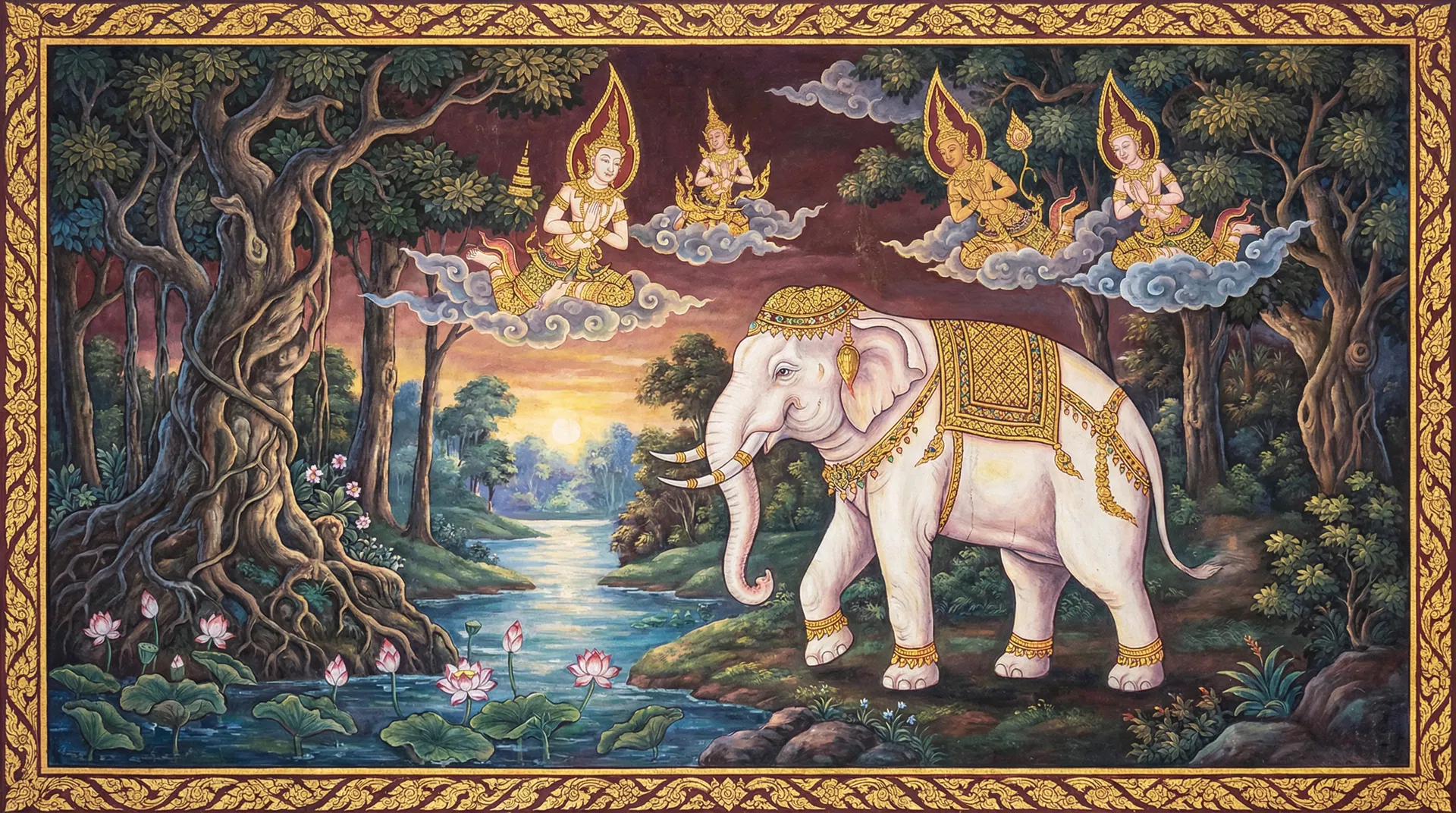
Samkicca Jātaka
The Humble Merchant's Resolve
In the bustling city of Varanasi, there lived a merchant named Samkicca. He was not born into wealth, but through his diligence, honesty, and keen business sense, he had built a thriving enterprise. He was known throughout the land for his fair dealings and his unwavering integrity.
One day, Samkicca decided to embark on a long and perilous journey to a distant land to procure rare spices and precious silks. He assembled a caravan of merchants, loading their carts with goods to trade. As they prepared to depart, a group of bandits, notorious for their cruelty and greed, learned of Samkicca's journey.
Led by a fearsome chieftain named Bhayankara, the bandits planned to ambush Samkicca's caravan and seize all their valuables.
As the caravan ventured deep into a dense forest, the air grew heavy with an ominous silence. Suddenly, from the shadows, the bandits emerged, their weapons glinting menacingly. "Halt!" roared Bhayankara. "Surrender all your goods, or face our wrath!"
The merchants in Samkicca's caravan trembled with fear. Some began to cry, while others pleaded for their lives. They were outnumbered and outmatched.
Samkicca, though his heart pounded, stood firm. He looked at his frightened companions and then at the menacing bandits. He knew that violence would only lead to further bloodshed and loss. He remembered the teachings of compassion and the strength that comes from a resolute spirit.
"Bhayankara," Samkicca called out, his voice steady despite the fear, "we are merchants, not warriors. We carry goods to trade, not to fight. If you seek wealth, we can offer you what we can spare, but we wish to continue our journey in peace."
Bhayankara laughed cruelly. "Spare? We want it all! Your possessions, your lives, everything!" He gestured to his men, who began to advance.
Seeing that words alone would not deter them, Samkicca made a bold decision. He turned to his fellow merchants. "My friends," he said, his voice filled with determination, "we have two choices: to succumb to fear and lose everything, or to stand together with courage and protect what is ours." He then addressed Bhayankara again. "If you wish to take our goods, you will have to take them from us. But we will not surrender them willingly. We will defend ourselves, not with violence, but with our resolve."
Samkicca then instructed his merchants to begin singing. It was not a song of fear or despair, but a song of unity, resilience, and hope. As they sang, Samkicca picked up a sturdy staff and stood at the forefront of the caravan, his posture conveying an unyielding spirit.
The bandits, expecting a panicked scramble or a futile fight, were taken aback by this unexpected response. The merchants, their voices rising in a powerful chorus, began to march forward, not aggressively, but with a steady, unwavering pace. Samkicca, the staff held high, led them, his eyes fixed on Bhayankara.
The bandits, accustomed to preying on fear and weakness, found themselves unnerved by the merchants' collective calm and their resolute march. The singing, instead of sounding weak, echoed with a strength that seemed to emanate from their shared determination. Bhayankara, the chieftain, felt a strange unease. He saw no fear in Samkicca's eyes, only a quiet resolve.
He tried to rally his men, but they hesitated. The sight of the united merchants, their voices a unifying force, and Samkicca's unwavering stance, had a disarming effect. They were not facing cowering victims, but a determined community.
After a tense standoff, Bhayankara, realizing that his usual tactics were failing and that this confrontation might turn costly, grudgingly ordered his men to retreat. "This is not worth the trouble," he grumbled, his pride wounded. "They are mad."
The bandits melted back into the forest, leaving the caravan unharmed. The merchants rejoiced, their voices turning from song to cheers of relief and gratitude. They praised Samkicca for his courage and his ingenious plan.
Samkicca, humble as ever, replied, "It was not my plan alone, but our collective resolve. When we stand united, even the greatest threats can be overcome. Our strength lies not in weapons, but in our spirit and our willingness to face adversity together."
The caravan continued its journey, reaching its destination safely. Samkicca returned to Varanasi a hero, not for his wealth, but for his bravery, his integrity, and his ability to inspire courage in others, proving that a firm resolve, even in the face of overwhelming odds, can achieve what brute force cannot.
— In-Article Ad —
💡Moral of the Story
True strength lies not in physical might or aggression, but in unwavering resolve, unity, and the courage to face adversity with a determined spirit. Collective action and inner fortitude can overcome even the most daunting threats.
Perfection: Truthfulness (Sacca)
— Ad Space (728x90) —
More Jataka Tales You May Enjoy
 547Mahānipāta
Mahāsutasoma Jātaka
The Tale of the Great Sutasoma In the city of Indapatta, ruled a wise and just king named Pāṭaliputt...
💡 The unwavering commitment to truth, even in the face of death, possesses a transformative power that can overcome the deepest darkness and bring about profound change.
 282Tikanipāta
Sutasoma Jātaka
Sutasoma JātakaLong ago, in the land of Kasi, there lived a wise and virtuous king named Sutasoma. H...
💡 True strength lies in compassion, forgiveness, and selflessness. Kindness can conquer even the most hardened hearts.
 374Pañcakanipāta
Mahādhammapāla Jātaka
Mahādhammapāla JātakaIn the verdant land of Kasi, where the sun cast a golden hue upon rolling hills...
💡 Deceptive gifts and false alliances often mask hidden agendas. True strength and victory are achieved through righteousness, wisdom, and genuine preparedness.
318CatukkanipātaMahosadha Jataka
Mahosadha JatakaIn the ancient city of Mithila, capital of the prosperous kingdom of Videha, lived a...
💡 Intellect and wisdom, when combined with foresight and compassion, are the most powerful tools for resolving conflicts, ensuring justice, and promoting the welfare of society.
 420Aṭṭhakanipāta
Mahakapi Jataka
The Tale of the Great Monkey KingIn the verdant jungles of the Himalayas, where snow-capped peaks ki...
💡 Selflessness, justice, and keeping one's word are the highest virtues of leadership, even when faced with personal loss.
 379Chakkanipāta
Kumbha-jātaka
Kumbha-jātakaIn a serene monastery nestled on the slopes of a gentle hill, lived a community of monk...
💡 True skill and service are not merely about outward performance or confidence, but about complete awareness, humility, and a deep respect for the task and its surroundings. Pride can be a greater source of failure than lack of ability.
— Multiplex Ad —